


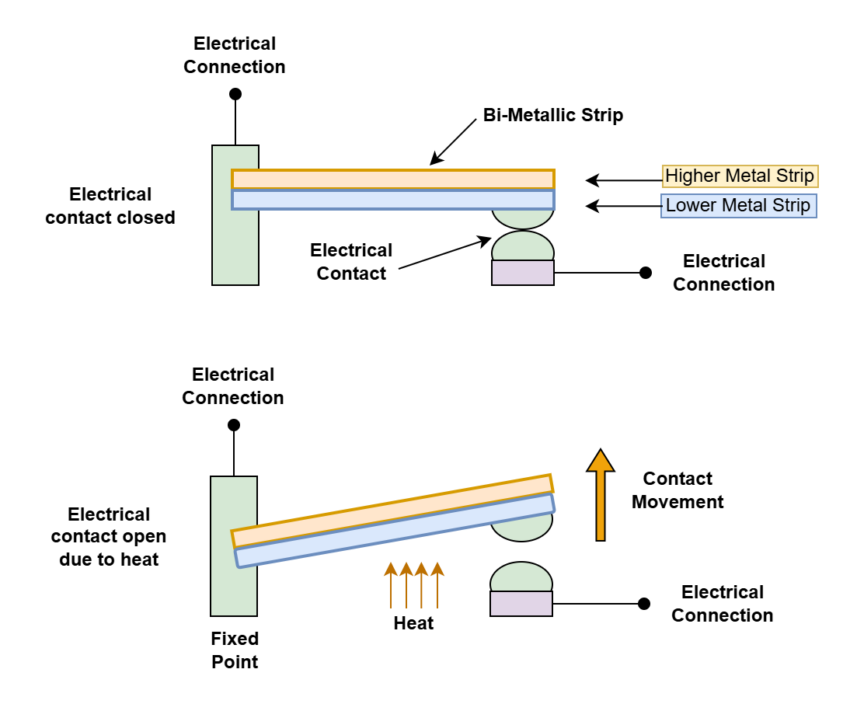
The thermostat is an electromechanical temperature sensor or switch of the contact type. It is essentially made of two distinct metals, such as copper, tungsten, nickel, or aluminium, that are joined to form a Bi-metallic strip. When the strip is heated, the two dissimilar metals’ varying linear expansion rates cause a mechanical bending movement.
The bi-metallic strip is widely used to control hot water heating elements in boilers, furnaces, hot water storage tanks, and vehicle radiator cooling systems. It can be used as an electrical switch on its own or as a mechanical means of operating an electrical switch in thermostatic controls.
Features
-
Temperature sensors are broadly categorized into contact and non-contact types. Contact sensors (e.g., thermostats, thermistors, RTDs, thermocouples) require physical contact, while non-contact sensors detect temperature via radiation or convection (e.g., infrared sensors). Thermostats are electro-mechanical contact sensors using bi-metallic strips that bend with heat, creating or breaking electrical connections. They come in snap-action (quick ON/OFF) and creep-action (gradual response) types, and are commonly used in home heating systems. Thermistors are temperature-sensitive resistors made from ceramic materials. Most are NTC (Negative Temperature Coefficient), meaning resistance decreases with increasing temperature. They’re precise, fast-responding, but nonlinear. RTDs (Resistive Temperature Detectors) use metals like platinum and have a positive temperature coefficient, making them highly accurate and stable. Their resistance increases linearly with temperature but changes slowly, requiring compensation circuits for accuracy.